
Who decides the “autumn leaves day”? How Japan’s weather agency watches maple and ginkgo
Japanese news reports the day the maple leaves turned red. It is recorded by the Japan Meteorological Agency (JMA), using set sample trees and one standard nationwide. Here is how it works and how autumn colour moves south.
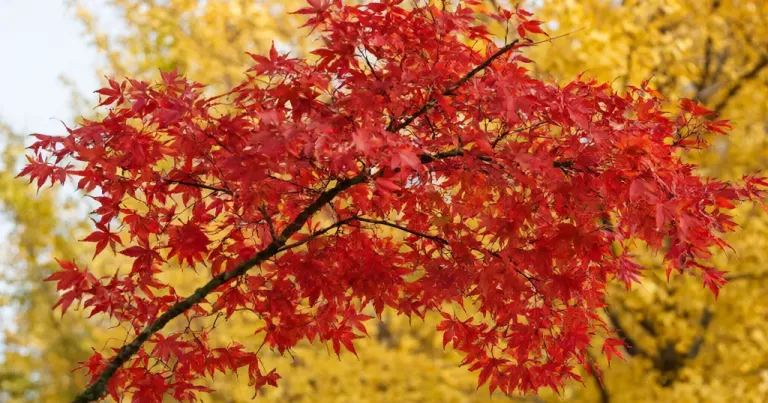
In autumn, Japanese news sometimes says: “the maple turned red today.” That day is not picked by feel: the Japan Meteorological Agency (気象庁) records it as part of its “phenological observation” (生物季節観測), at weather stations across the country, using one unified standard.
How the day is defined
The JMA observes a fixed sample tree (標本木).
| Observation | JMA definition (summary) |
|---|---|
| Maple red-leaf day (かえで紅葉日) | The first day when, looking at the whole sample tree, most of the leaves have turned red |
| Ginkgo yellow-leaf day (いちょう黄葉日) | The first day when, looking at the whole sample tree, most of the leaves have turned yellow |
For maple, the sample tree is mainly the iroha-kaede (Japanese maple). Where it does not grow, yama-momiji, ō-momiji or itaya-kaede are observed instead. For both maple and ginkgo, the JMA also records leaf fall.
What the JMA observes in plants today
At the end of 2020 the JMA ended some of its observations. As of January 1, 2021, it observes these 9 plant phenomena:
- flowering of the ume (Japanese apricot)
- flowering and full bloom of sakura (cherry)
- flowering of ajisai (hydrangea)
- flowering of susuki (Japanese pampas grass)
- yellowing and leaf fall of the ginkgo
- reddening and leaf fall of the maple
Red leaves travel from north to south
Based on the JMA’s 1991–2020 normals, maple reddening moves roughly like this:
- Mid-October: starts in eastern Hokkaido (Pacific side)
- Around November 20: Tohoku and eastern Hokuriku
- Around November 30: Kanto, Hokuriku, Tokai, Chugoku, Shikoku and northern Kyushu
- Early to mid-December: the Pacific coast of Kanto and Tokai, Kinki and southern Kyushu
Ginkgo yellowing starts in late October in eastern Hokkaido (Pacific side) and the Pacific side of Tohoku, and reaches the Pacific coast from Kanto to Tokai, Kinki, Chugoku, Shikoku and Kyushu from the end of November to early December.
Everyone knows the spring news about cherry blossoms — and in autumn the JMA observes just as carefully.
Each year’s dates and local records are on the JMA page “生物季節観測の情報”.
Sources
- 気象庁 生物季節観測の情報 www.data.jma.go.jp
- 気象庁 かえでの紅葉日(解説・等期日線図) www.data.jma.go.jp
- 気象庁 いちょうの黄葉日(解説・等期日線図) www.data.jma.go.jp
This content reflects the publication date. Laws and rules change — always check the official source.