
5S basics: sort, set in order, shine, standardize and sustain on the factory floor
5S is not just “cleaning day” — it is a system for safer, easier work. Here is what each S means, based on Japan’s Ministry of Health, Labour and Welfare, and how to start.
Anyone who starts working in a Japanese factory or warehouse soon hears about 5S. Many people think it simply means cleaning, but the real goal is to prevent injuries and make work easier.
The workplace safety site of Japan’s Ministry of Health, Labour and Welfare (職場のあんぜんサイト) describes the original 4S (seiri, seiton, seisō, seiketsu) as an activity for a safe, healthy workplace and higher productivity. Adding shitsuke (discipline) gives the 5S widely used in Japanese companies.
What each S means
| S | Meaning (summary) |
|---|---|
| Seiri (整理) – sort | Separate what is needed from what is not, and remove the unneeded |
| Seiton (整頓) – set in order | Keep needed items in a fixed place and quantity, ready to grab |
| Seisō (清掃) – shine | Remove dirt, dust and oil so that problems become visible |
| Seiketsu (清潔) – standardize | Keep that condition; keep your body and clothes clean too |
| Shitsuke (しつけ) – sustain | Make sure everyone follows what was agreed and taught |
Why the order matters
If you tidy a shelf (seiton) without first removing what you don’t need, it fills up again within days. Sort first to reduce, then set in order to fix places. In this order it takes less effort and lasts longer.
How 5S prevents accidents
- Clear walkways → fewer trips and falls
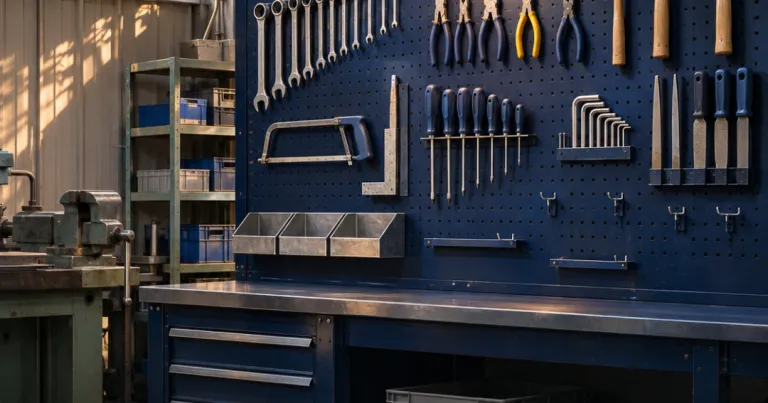
- Fixed places for tools → no time lost searching, fewer awkward postures
- No oil or metal chips on the floor → fewer slips, and machine oil leaks are spotted early
- Everyone follows the rules (shitsuke) → the workplace stays safe even when the team changes
Small steps you can take today
- Mark anything on your workbench you did not use last week (sort)
- Tape outlines for your most-used tools and label them (set in order)
- Use the last 5 minutes of the shift for cleaning (shine)
- Take a photo of the tidy bench and post it next to it (standardize)
- Review one rule at the morning meeting (sustain)
5S is never “done”. The shortest path is to make everything understandable at a glance — and keep it that way.
At the KOMORI factory, sorting and setting in order are also the foundation of safe work. If you are new to a factory in Japan, start by learning where everything goes.
Sources
- 職場のあんぜんサイト(厚生労働省)安全衛生キーワード「4S(整理、整頓、清掃、清潔)」 anzeninfo.mhlw.go.jp
This content reflects the publication date. Laws and rules change — always check the official source.