
Machine Safety Design Basics: Concepts and On-Site Checks
Definitions of fail-safe and fool-proof, types of guards, and design elements for on-site verification.
Fixing to a Safe State During Failures
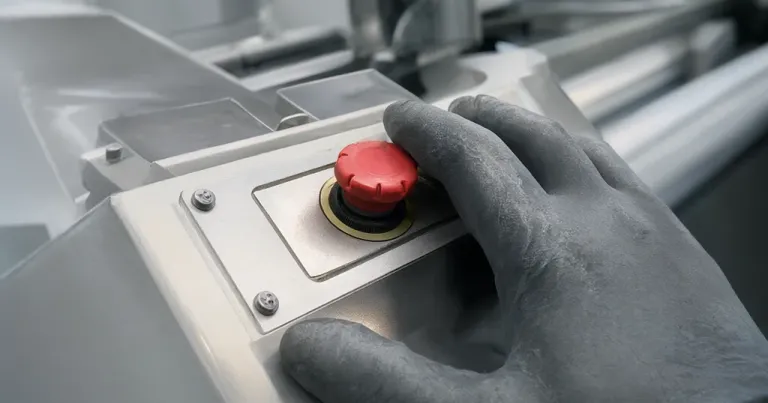
In machine safety design, the fail-safe concept is crucial. It refers to a mechanism that, even if the system or components fail, fixes the state to a predefined safe condition to prevent occupational accidents and limit the impact of the failure.
For example, in safety devices of many industrial machines, if safety functions are compromised by component damage or functional degradation, emergency stop measures are taken. Additionally, restart prevention circuits, which prevent the machine from restarting after an emergency stop or power restoration unless the operator performs a restart operation, are also control mechanisms based on this concept.
Measures Based on Human Characteristics
The fool-proof concept assumes that humans make mistakes due to carelessness, misunderstanding, or incorrect judgment. Accidents caused by "not knowing" are prevented through education, but measures are needed to prevent errors stemming from human characteristics.
Specifically, this includes enlarging machine operation displays, color-coding and shape differentiation of operating devices, and aligning the direction of operation with the machine's movement direction. Furthermore, if actions contrary to expectations occur despite these measures and are expected to lead immediately to a disaster, it is desirable to take additional countermeasures.
Examples of On-Site Verification Items
As examples of items to verify on-site, there are the types and functions of guards. A fixed guard has a structure where workpieces or tools can enter through openings, but hands cannot reach the danger zone. An adjustable guard allows shape and dimensions to be adjusted according to the workpiece or tool. A warning guard allows hands to enter the danger zone but provides a warning beforehand. An interlock guard does not open while the machine is operating, and the machine does not start if it is open.
For example, as a procedure for selecting document items, one might first select "Types of Guards" and then check the details of the "Interlock Guard."
Understanding these design philosophies and verifying how your company's machines are protected from various perspectives contributes to maintaining a safe working environment.
Sources
- 厚生労働省 職場のあんぜんサイト anzeninfo.mhlw.go.jp
- 厚生労働省 職場のあんぜんサイト anzeninfo.mhlw.go.jp
This content reflects the publication date. Laws and rules change — always check the official source.